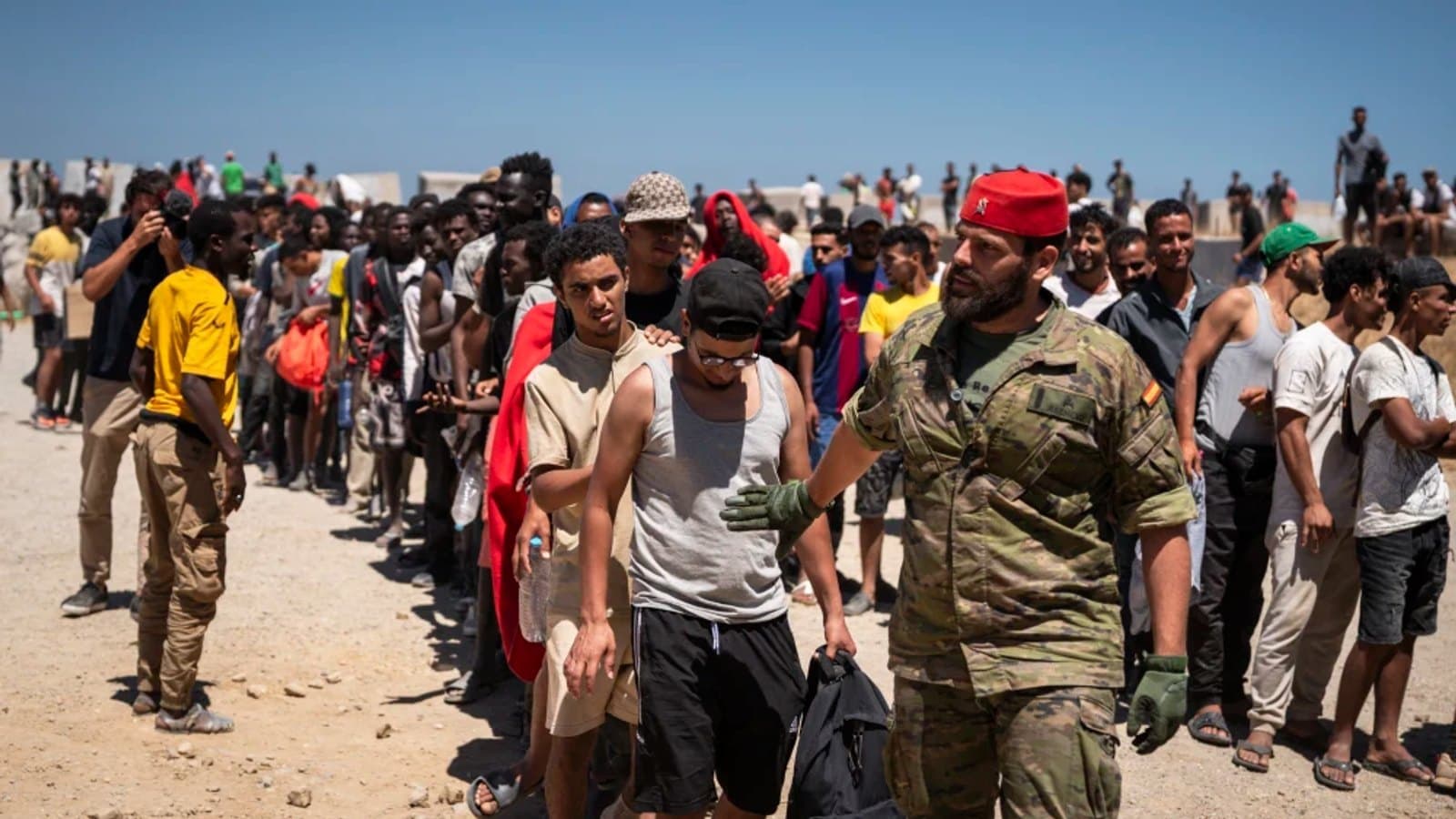
Spain restricted leave for Civil Guard and army personnel stationed in Ceuta and Melilla ahead of August 15, after intelligence pointed to another mass border crossing being planned for that date, a direct response to warnings that the crisis triggered by the late July rush into the enclave was not necessarily finished.
What made those warnings credible was a report from the Golden Owl research group, linked to the University of Alicante, which concluded that the original crossing in late July was not a spontaneous surge but a coordinated, prepared and advertised operation. Investigators traced recruitment activity on social media built around anti Moroccan sentiment and emigration presented as a solution, evidence that whoever organized the first crossing had both the reach and the intent to try again.
The toll from that first crossing is still being counted two different ways. Spanish authorities put the death count at 83 during the July 30 and 31 rush, while a Moroccan human rights organization has put the figure as high as 141, a gap neither side has closed. Around 1,400 migrant children remain in Ceuta, a city of roughly 84,000 people, with many still sleeping on beaches while hundreds of minors register outside police headquarters for eligibility for state support.
Prime minister Pedro Sanchez has called the original crossing a violation of Spain's territorial integrity. Italian prime minister Giorgia Meloni and Danish prime minister Mette Frederiksen have taken a different angle, warning of rising crime, increasing pressure on public services and an erosion of public trust, the language behind their push for Brussels to treat Spain's handling of the crisis as an EU wide problem rather than a Spanish one. Ceuta's own civic leaders, spanning the city's Catholic, Muslim, Jewish and Hindu communities, put it more simply in a joint statement: the city cannot face alone a situation that completely overwhelms its capacities.