
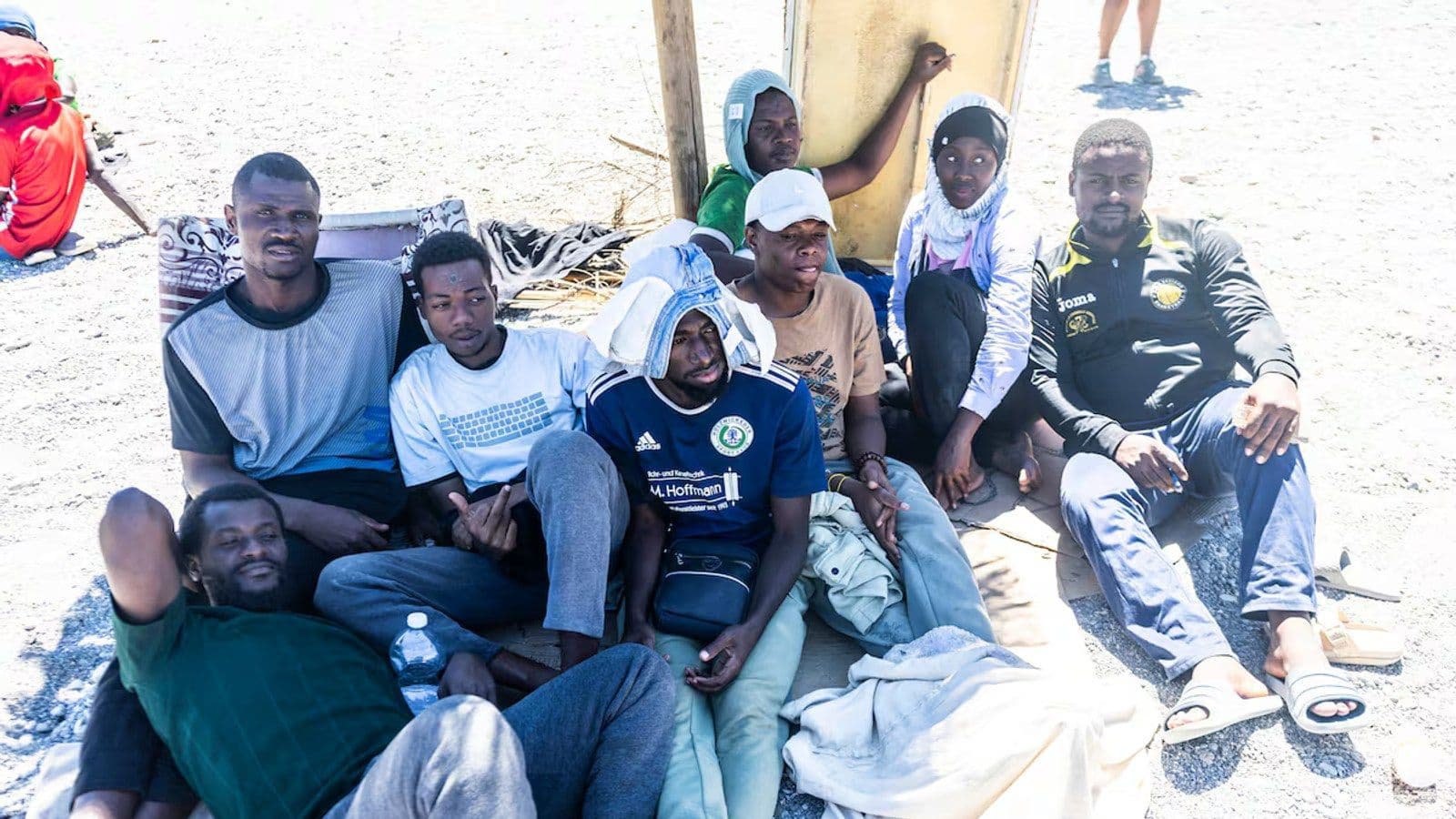
Around four hundred people, almost all men, are living on Trampolin beach in Ceuta, a cove of roughly 140 metres. The Temporary Immigrant Shelter above the town has no room left, so the beach has become the overflow. They shelter from an August that sits at 35 degrees under Red Cross blankets and structures improvised from cardboard and cloth, and the police who watch the promenade class the cove as one of the city's hot spots.
The reporting that describes them is worth reading in full, because it does the thing a figure cannot. A 23 year old from Anambra in Nigeria who swam across last Thursday asks passers by to share their internet so he can tell his mother he is fine, then admits he lied to her a little, and concludes it is better that way. A family of seven from the Comoros sleeps under one of the few straw umbrellas, having fled first to Mayotte and then saved for a flight to Morocco; the eldest is a telecommunications engineer of 30 who says he had no future there. His sister, one of the few women on the beach, doubles over in pain and asks quietly how she might get sanitary pads.
A 32 year old Yemeni holds a passport stiffened and faded by seawater, five years and seven countries into a journey that took him through South Sudan, Sudan, Djibouti, Libya, Algeria and Morocco. His brother went into the water with him last Thursday near the El Tarajal jetty and did not come out. He has asked the police and the aid workers, and nobody can confirm the loss either way.
One word carries across the cove. Asylum. It is what they crossed for, after WhatsApp groups told them the border was open, and it is the one thing they can name about their own situation. They understand that they cannot be summarily returned to Morocco the way roughly 60,000 people were, according to the interior ministry's own count. What nobody has explained is how that understanding turns into a procedure, a roof, or a queue to stand in. They ask, and the answers do not come, so they wait on the sand.
At the far end, beside the desalination plant, television crews file live reports with the people they are reporting on standing quietly behind them. When the cameras stop, those people come forward and talk, sometimes shouting before the feed cuts.
El Tarajal, the other hot spot until two days ago, is quiet now, with the military presence reduced and Moroccan children diving off the rocks. The crisis has moved off the border and into a cove, which is a smaller story and a harder one, because there is no barrier to install and no summit to convene. There are four hundred people, one word, and no process attached to it.