
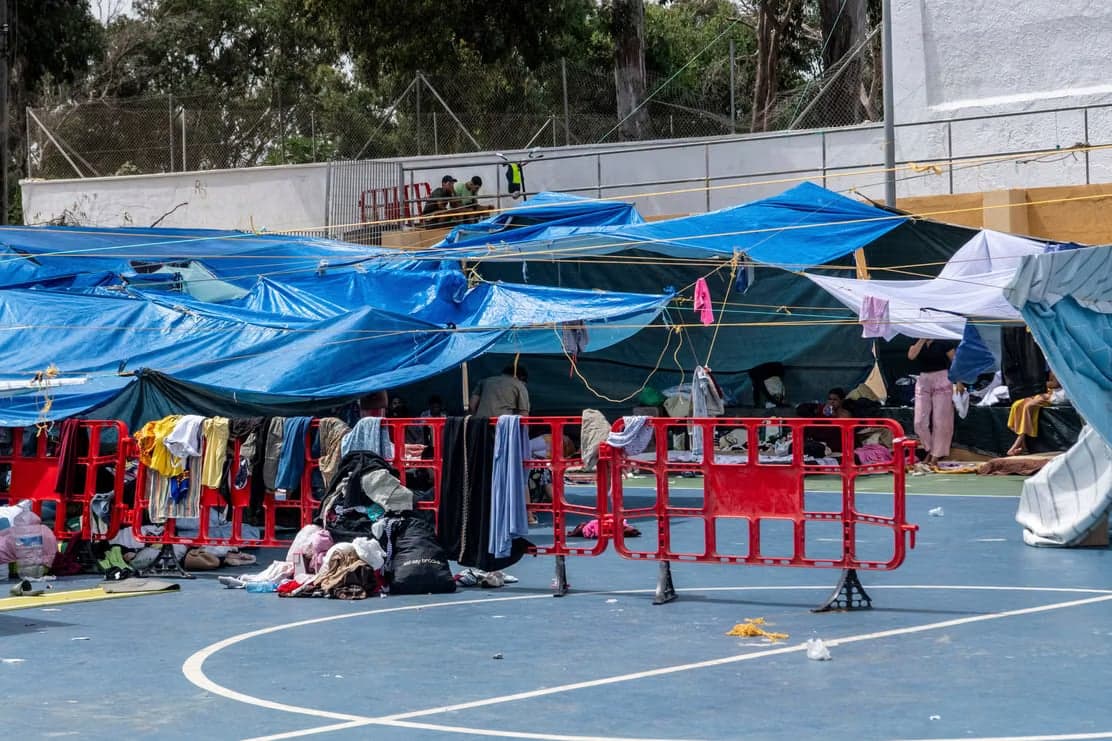
The Spanish government is building two new temporary reception facilities in Ceuta with a combined capacity of 1,800 spaces, an attempt to get migrants off the streets and beaches nearly three weeks after a mass crossing overwhelmed the enclave. Officials described the sites as an initial phase that will keep expanding as adaptation work on the buildings continues.
The crisis traces back to July 30 and 31, when roughly 72,000 people crossed the border from Morocco into Ceuta in one of the largest and deadliest rushes the Spanish territory has seen. Around 70,000 have since been returned to Morocco, but several thousand remain, including unaccompanied minors who cannot be summarily deported under Spanish law.
For the past three weeks, many of those who stayed have had nowhere to go, sleeping rough on pavements and along the beach with little reliable access to food, clean water or toilets. Aid groups have repeatedly flagged the danger this poses to women and girls in particular, and residents in Ceuta have complained of worsening sanitation and security problems in the areas where people have gathered.
Ruben Perez Correa, Spain's Secretary of State for Children, defended the government's handling of unaccompanied minors, saying mass deportations of children are illegal under Spanish law. He said many of the young people arriving come from what he called very complex family situations and require specialised care rather than removal.
Among the plans tied to the shelter expansion is a proposal to transfer roughly 500 unaccompanied girls, some as young as 10 or 11, from Ceuta to facilities on the Spanish mainland. The move has drawn opposition from conservative and far right parties, while the governing left backs the transfers as consistent with existing child protection law.
The new facilities are billed by officials as alternative accommodation meant to end street sleeping in Ceuta, though no firm date has been given for when they will be fully operational or reach their combined capacity.